Tekstit

Evaluation in personalized teaching

Kuva
The idea of evaluation is to signal the level of student’s knowledge and skills to the student him/herself and possibly to employers etc. The student benefits from the evaluation because it signals how much the student has learned. It can also function as an incentive to work harder to achieve better grades. Typically, the grading system of a course is connected to the course aims and there are criteria provided for each grade. If one achieves all the goals, one gets top grades, if not the grades are lower. There is also a minimal level one has to accomplish to pass the course. For the education provider, the grading systems make sure, that everyone who graduates, has the skill level required in that specific course or education. The challenge of evaluation is to measure the right things and in a way that is consistent. The assessment should be unambiguous and not vary by the teacher’s mood or liking of a particular student. It would be good to have clear and public criteria for asses...
Intelligence, talent and learning styles

Kuva
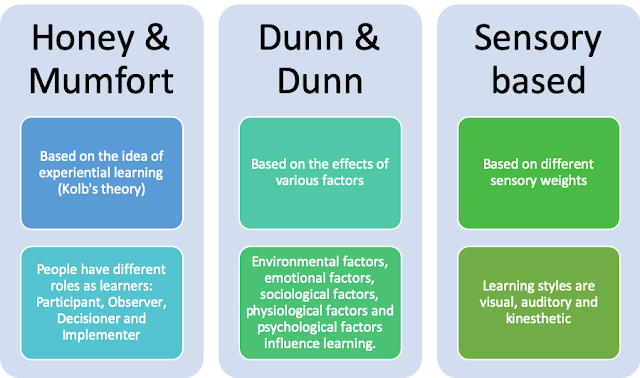
Howard Gardner argues that intelligence is a multi-dimensional concept. Humans have a variety of specialized and partly independent intelligence. According to Gardner, intelligence is a biopsychological information processing ability, which is also influenced by culturally learned practices and values. The types of intelligence are: linguistic (comprehension and self-expression), mathematical-logical (problem-solving and coherent reasoning), musical, physical, spatial and visual (perceive spaces, directional, easily understand essential features of objects), intrapsychic (ability to understand own weaknesses and strengths) and interpsychic (the ability to get along with others and understand them). Gardner's listing has been criticized because those kinds of intelligence are mainly based on intuition. It has been argued that intelligence could be regrouped and named in so many different ways and that Gardner’s list is lacking potential intelligence such as philosophical and abstra...

Comparing government educational plan and monetary incentives from the perspective of Universities of Applied Sciences (Case Finland)

Kuva
The educational plan stresses the importance of equal opportunities for all. It pays attention to the equality of minor language groups such as Swedish/Same speaking kids, people living in different areas and immigrants.  The main idea is that education and civilization is the best guarantee for young people to find their place in society and integrate. This is a base for innovations and visions and balanced development of the society.   The aim is that all the young people get second-degree schooling and 50% get a University degree by 2030. In practice, this means that Universities need to have more students. This seems like a pretty ambitious plan. Even though the educational level of Finns gets better each year, there is still a long way to go. The figure below illustrates how the educational level of Finns is developing.  Since most university funding comes from the state the way the funding is divided guides how the Universities organize their ...

How do the law and norms guide teaching in professional education in Finland?

One can be a great teacher even without any certificates, but the certificates guarantee a certain level of knowledge of all the teachers about pedagogics, human development, human learning, learning psychology, etc. Since I plan to teach at the University of Applied sciences, I have especially paid attention to relevant parts of education law. It says that: “The mission of the University of Applied Sciences is to provide higher education based on the requirements of working life and its development, as well as research, artistic and cultural backgrounds, and to support the student's professional growth.” Additionally, the University of Applied Sciences (later UAS) needs to do research, which helps working life, territorial development, and lifelong learning. The UAS in Finland is a non-profit organization.  It operates closely with working life and other universities. One needs to get a license to establish a UAS in Finland. The license “determine which degrees and associated ti...

The role of education in shaping Finnish society

According to the Ministry of Education in Finland (2017), the Finnish strengths of the Finnish educational system is the ability to successfully combine high-quality teaching with efficiency and equality. Finland is such a small country that we have long recognized how important it is to recognize and utilize the talents of all of the citizens. Maybe be due to this fact Finnish people appreciate and value education and science. We think that know-how is the core of Finnish society. According to the Ministry of Education Finland is a that stresses the importance of creativity in teaching and learning. To sum up, the key to success has been creativity, equality, and efficiency. The idea of equal opportunities is at the core of Finnish society. Even the most radical right politicians think that education should free for all in Finland. This is something everyone seems to agree. That said, there are big disagreements on the content of the education and how it should be organized. People ...

Learning in different phases: What teachers should know

Research in developmental psychology has a tradition of just over 100 years. The first work on the subject was "The soul of a child" written by the German physiologist William Preyer (Ruoppila 1995). Children's intelligence and cognitive development were initially studied mainly through questionnaires. The aim was to correct and prevent developmental delays. Big names in developmental psychology include Sigmund Freud, Carl Gustav Jung, Jean Piaget, Lev S. Vygotski and Erik. H. Erikson. Key concepts in developmental psychology include biological maturation theories, environmental learning theory, constructivist theories, and cultural development theories (Cole & Cole 1993). Essential research questions include the continuity or discontinuity of development, the question of what makes a person develop, how much the environment affects, how much genes affect, and how individual differences are formed. A related discipline is Social Psychology (Korkiakangas 1995). It typ...

Different human perceptions and future of learning

Kuva
The technological advancements transform our society at such a rapid pace, that it is difficult to foresee what kind of knowledge and skills the future adults need. It seems clear, however, that teaching and learning needs to adapt to fulfill those (yet unknown needs). According to Linturi (2014), this means that teaching and learning will be personalized, and it will be more focused on teaching skills than transferring knowledge. The responsibility of learning will be transferred from the teacher to the learner. Since society is more and more socially constructed it is essential to learn co-operation and working in groups.  When considering these changes in the light of different human perceptions we notice that there are some challenges to consider (in red color in the figures above and below). There is no big change in the light of human perceptions on whether the students are taught skills or knowledge. The present system is easy to apply ( Behavioristic, Freudian, K...